

The Top 5 Vocabulary Terms That Trip Students Up on the Florida Real Estate Exam
Starting a new career path is incredibly exciting, but preparing for the final state evaluation can feel a bit like learning a completely new language. If you are currently working your way through a florida real estate pre-licensing course, you already know just how much information you need to absorb.
When it comes to passing the 100-question state exam administered by Pearson VUE, vocabulary is half the battle. The Florida Real Estate Commission (FREC) legal standards require precise knowledge, and the examiners love to test you on terms that sound similar but mean completely different things in practice.
To help you study smarter, here are five of the most commonly confused vocabulary terms that trip students up—and exactly how to keep them straight.
1. Culpable Negligence vs. Fraud
Both of these terms involve doing something wrong in a transaction, but the intent behind them changes everything.
Fraud occurs when an agent intentionally misrepresents a material fact to deceive someone, resulting in financial harm.
Culpable Negligence, on the other hand, doesn't require intent. It occurs when you are simply so reckless, careless, or intentionally blind to your duties that you guide a client into harm without meaning to.
Study Tip: Remember, you can be disciplined by FREC for a mistake even if you "didn't mean to do it." If you should have known better, it's culpable negligence.
2. Conversion vs. Commingling
These are the two biggest mistakes an agent can make when handling earnest money deposits, and mixing them up on the exam is a classic pitfall.
Commingling is the act of mixing a client’s trust funds with personal or business funds. For example, depositing a buyer's escrow check directly into your brokerage operating account.
Conversion happens when you actually spend or use that client’s money for personal or business expenses.
Study Tip: Think of Commingling as Combining funds, and Conversion as Converting someone else's money into your own pocket. Both are serious violations!
3. Blockbusting vs. Steering
Both of these are illegal practices under the Fair Housing Act, but they target different audiences.
Blockbusting involves convincing homeowners to sell their properties cheaply by implying that a protected class (e.g., a specific race or nationality) is moving into the neighborhood, which will cause property values to drop.
Steering is directing a potential homebuyer toward or away from certain neighborhoods based on their protective class, rather than their housing criteria.
Study Tip: Blockbusting targets sellers (busting up a block), while steering targets buyers (steering them down a specific road).
4. Actual Notice vs. Constructive Notice
This pair tests your understanding of legal ownership and title recording.
Actual Notice is direct, firsthand knowledge of a fact. For example, if a seller hands you a deed and says, "Look, I own this property," you have actual notice.
Constructive Notice (also called legal notice) is achieved by recording a document in the public records. Even if a buyer never drives down to the courthouse to look at the records, the law assumes they know about it because it is publicly available.
Study Tip: Recording a deed in public records always creates constructive notice. It tells the entire world, "This property is mine."
5. Bilateral vs. Unilateral Contracts
Contracts make up a massive portion of the state exam, and you must know the difference in how promises are exchanged.
Bilateral Contract: A promise for a promise. Both parties are legally bound to perform. (e.g., A standard residential sales contract where the seller promises to give the deed and the buyer promises to give the money).
Unilateral Contract: A promise for an act. Only one party is obligated to perform, and the second party only has to act if they choose to.
Study Tip: An open listing agreement or an option contract are classic examples of unilateral contracts. The seller promises to pay a commission if an agent brings a buyer, but the agent isn't legally forced to go look for one.
Final Thoughts: Focus on the Nuances
The secret to mastering the frec license requirements and passing your exam on the first try isn't just memorizing definitions—it’s understanding how these concepts apply to real-world scenarios.
If you want to move past simple flashcards and truly understand the legal mechanics of a successful real estate career, finding the right classroom environment matters.
Ready to turn these confusing legal terms into a rewarding new profession? Explore our upcoming schedules for the 63-hour real estate course online and in-person sessions at Moulder’s Real Estate School in Pensacola. Let’s get you prepped, confident, and licensed!
GET YOUR CAREER STARTED NOW
Can You Really COMPLETE Your Florida 63-HOUR Real Estate COURSE in Just One Week?
Thinking about a career change but worried you don't have months to spend in a classroom?
Here’s the good news: You don’t need months. At Moulder's School of Real Estate, you can knock out your entire Florida FREC-approved 63-hour pre-licensing education in exactly seven days. If you are ready to hit the ground running, our immersive classroom course is designed to get you trained, tested, and ready for the state exam faster than any online module can.
Why the 7-Day Classroom Track Works Better Than Online
While online courses sound convenient, it’s incredibly easy to get distracted, get stuck on complex real estate math, or let a "go at your own pace" course drag on for six months.
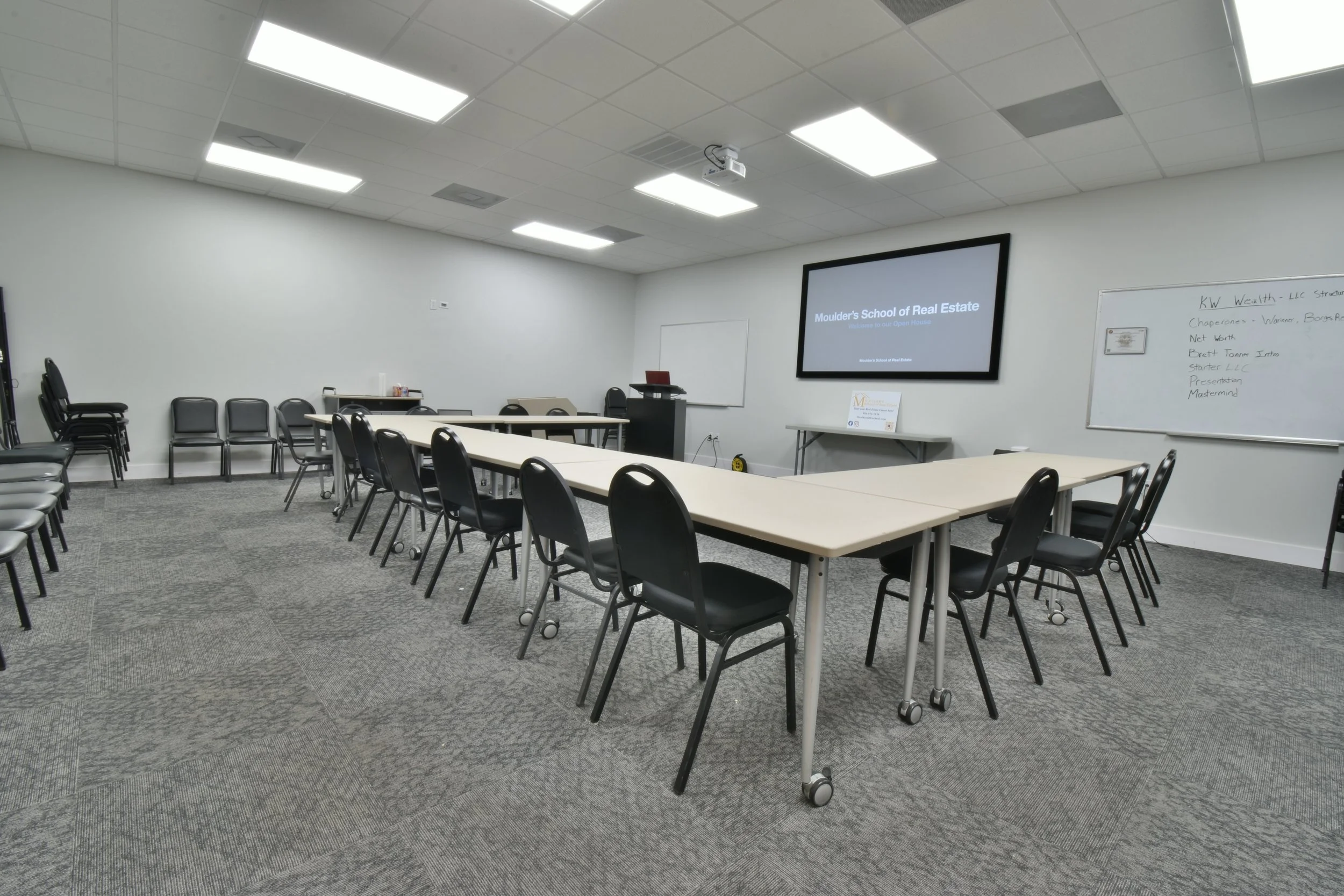
Our intensive 7-day course strips away the procrastination. When you step into our Pensacola training room, you get:
Total Immersion: You absorb the material quickly because you are living and breathing real estate for a week.
Instant Feedback: Stuck on a concept? Barry and Amy are right there to break it down until it clicks.
Higher Retention: Studying in a collaborative environment with peers helps you retain the tough laws and formulas you need to pass on your first try.
Next Week's Schedule: How It Breaks Down
We don't waste any time. We dive in, give you all the tools you need, and wrap it up in a single week. Here is exactly what your week looks like:
Monday through Saturday: 8:30 AM – 5:30 PM (Comprehensive classroom instruction, practice questions, and real-world examples).
Sunday: Class Test Day (Put your knowledge to the test and clear your final school hurdle!).
By Sunday evening, your required 63 hours are complete, your school exam is behind you, and you are ready to schedule your Florida state exam.
⏳ Seats are Limited – Secure Your Spot for Next Week!
Because this is an in-person, interactive class at our Langley Ave location, seating is strictly limited. Our 7-day immersion courses are highly popular because they allow you to jumpstart your new career without dragging out the process.
Don't push your dreams off until next month. Take the leap, dedicate one week to your future, and let's get you licensed!
👉 Click here to view the schedule and register for next week's 63-Hour Pre-Licensing Course!